Table of contents
Sharing videos
You can share a video using an embed code or a share link for all videos uploaded to Flowplayer OVP and all remote videos. To embed a video or livestream you need to select the video or livestream you want to embed and also make sure that you have a player configuration that you can embed the video or livestream within.
Once you have the video we provide the following ways to embed a video:
- Iframe embed code
- JavaScript embed code
The preferred method is iframe embed since that is easiest to use and most common across the Internet.
In order to embed a video please take the following steps:
- Find the video or livestream
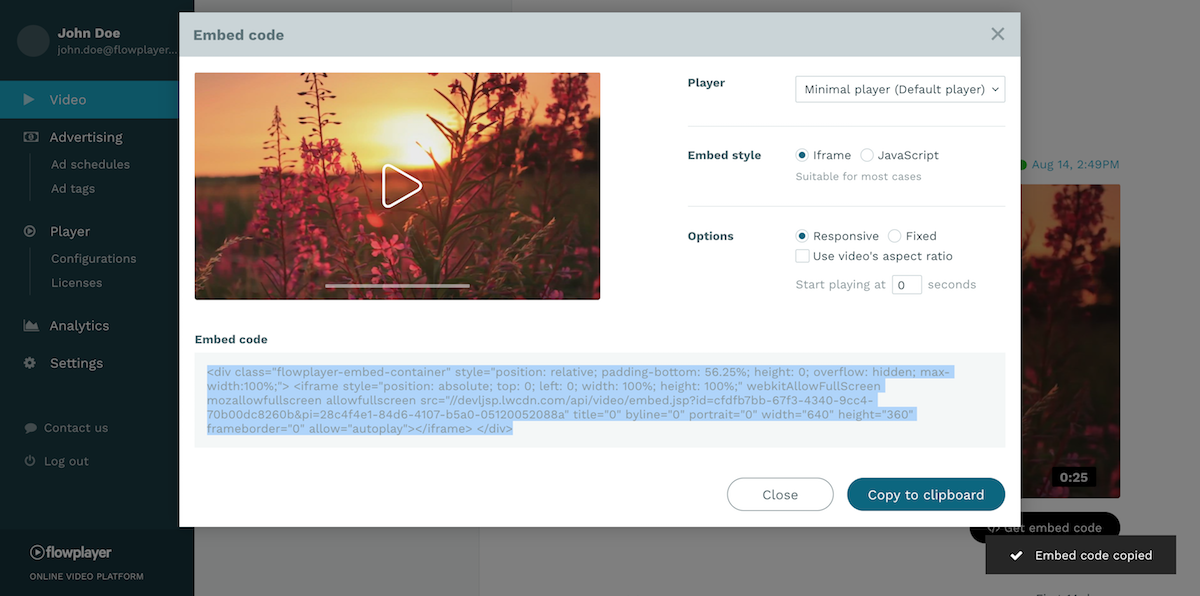
- Click the Share video button
- Choose a player and options to embed the video
- Copy paste the embed code using either iframe or JavaScript
- Alternatively, send a share link by email / messenger.
The most important player settings are indicated by the following icons in the player selection dropdown:
autoplay when possible
start muted
loop the video clip
If you cannot find a good player configuration to use in the third step please create a new player configuration that suits your specific requirements.
To learn more about advanced options to embed a Player using video files or streams outside of Flowplayer please see Publishing a player.
Embed a video or livestream using iframe
Using an iframe embed code is a standard way to embed videos and many video services provide this as the only option. This iframe embed provides you with the following advantages:
-
The code is easy to copy
-
The video player is isolated in its own “window” which prevents potential conflicts with other items on the page
The iframe embed code looks like this:
<div class="flowplayer-embed-container"
     style="position: relative; padding-bottom: 56.25%; height: 0; overflow: hidden; max-width:100%;">
  <iframe style="position: absolute; top: 0; left: 0; width: 100%; height: 100%;"
          webkitAllowFullScreen mozallowfullscreen allowfullscreen
          src="//embed.flowplayer.com/api/video/embed.jsp?id=35abac67-087d-47e5-82aa-2d22c4a0241e&pi=3480668e-2322-4c18-b11a-92af07d07dd6"
          title="0" byline="0" portrait="0"
          width="640" height="360"
          frameborder="0" allow="autoplay"></iframe>
</div>
The iframe embed link provide you with a few options to override the player configurations.
Using an iframe embed code limits the amount of interaction with the player since it resides in its own “window”. We always recommend to try to configure the player within our player builder as a first step since it contains a multitude of configuration options. However, if you want to access the player object directly and programmatically interact with it or customize it more than what is provided using the iframe embed options you should use the JavaScript embed code.
Embed a video or livestream using JavaScript
If you want to work with the player programmatically, use the JavaScript embed. It gives you direct access to the player instance and to the full Player API.The JavaScript embed code is an ESM embed and looks like this:
<div id="player-3afc64ea-fe85-456c-b9d7-6d1de8350ff2"></div>
<script type="module">
  import flowplayer from "https://embed.flowplayer.com/c5ad8e31-7bbe-441a-8c29-eaeca03ac6e1/3afc64ea-fe85-456c-b9d7-6d1de8350ff2.js";
  flowplayer("#player-3afc64ea-fe85-456c-b9d7-6d1de8350ff2", {});
</script>
The embed code is built from two IDs:
-
- Part
- Example
- Meaning
-
<div id="player-…">player-3afc64ea-…- The element the player is rendered into. By default the ID is
player-followed by the media ID.
-
- First URL segment after
embed.flowplayer.com/ 9cd385cc-…- The ID of the player configuration to use.
- First URL segment after
-
- Last URL segment (before
.js) 3afc64ea-….js- The media ID of the video or livestream.
- Last URL segment (before
-
flowplayer("#player-…", {})- Creates the player in the element matching the selector. The second argument holds optional configuration overrides.
The embed code has the same format for videos and livestreams. Use the livestream's ID as the media ID.
What is an ESM embed?
ESM stands for ECMAScript modules, the standard JavaScript module system built into all modern browsers. A <script type="module"> can import code directly from a URL, without a separate <script src> tag or a build step.
The URL you import from is not a static file. The Flowplayer embed service generates a small module for this exact combination of player configuration and media. When the browser imports it, the module:
- loads the Flowplayer player in the release version set in your player configuration
- loads the platform integration plugin and every plugin your player configuration uses, so you don't need to add plugin scripts yourself
- carries the player configuration and the media information (sources, poster, title and, where required, the playback token)
- adds the Flowplayer stylesheet to the page if it isn't there yet
- exports a
flowplayer()function that you call to create the player
Compared to the older async embed, an ESM embed:
- doesn't block page rendering: module scripts load in parallel and run only after the HTML has been parsed
- takes options as plain JavaScript: you pass an object to
flowplayer()instead of writing JSON inside a<script>tag - returns the player instance: you can use the Player API right away
Customizing the player
Any option you pass in the second argument overrides the player configuration for this embed. See configuration options:
<div id="player-3afc64ea-fe85-456c-b9d7-6d1de8350ff2"></div>
<script type="module">
  import flowplayer from "https://embed.flowplayer.com/c5ad8e31-7bbe-441a-8c29-eaeca03ac6e1/3afc64ea-fe85-456c-b9d7-6d1de8350ff2.js";

  const player = flowplayer("#player-3afc64ea-fe85-456c-b9d7-6d1de8350ff2", {
    start_time: 30,
    muted: true
  });

  player.on("playing", () => console.log("Playback started"));
</script>
Don't set src in the options object. The media is defined by the embed URL, and an src passed here replaces it.
Several players on one page: every player needs its own element with a unique ID. To embed the same video twice, give the second div a different ID and pass that selector to flowplayer(). Any CSS selector works as long as it matches exactly one element.
Legacy async embeds
The async embed is deprecated. It still works, but new embeds should use the ESM embed described above. Workspaces generate async embed codes only when use legacy JS embed code is checked in the workspace settings.
Older embed codes use the cloud-hosted async player script flowplayer.async.js and look like this:
<div data-player-id="9cd385cc-dd2b-4e85-9d11-9ab11c2b540f">
  <script src="//cdn.flowplayer.com/players/b6e0b310-9aa3-4f3b-9a30-cbbc3e9c04f3/native/flowplayer.async.js">
    {
      "src": "3afc64ea-fe85-456c-b9d7-6d1de8350ff2"
    }
  </script>
</div>
The embed code is built from three IDs:
-
- Part
- Example
- Meaning
-
data-player-id9cd385cc-…- The ID of the player configuration to use.
-
- URL segment between
/players/and/native/ b6e0b310-…- The ID of the workspace.
- URL segment between
-
"src"in the JSON inside the<script>tag3afc64ea-…- The media ID of the video or livestream.
Additional configuration options are added as JSON next to src inside the <script> tag.
To move to ESM embeds, uncheck use legacy JS embed code in the workspace settings and copy the new embed code from the Share video dialog. You can also build it yourself: the player configuration ID and the media ID go into the import URL, and the workspace ID isn't needed anymore.
CDN
All Flowplayer OVP video assets will be delivered through our Enterprise Content Delivery Network with worldwide points of presence.
Share a link
Additionally, you can copy a share link from the Share video dialog and send it by email or messenger.

If you use a player configuration with host restrictions, you must allow ljsp.lwcdn.com in the host configuration in order to allow recipients to view the video.
Video analytics are available for videos hosted by us and for remote video assets, ie if they are registered in our system and you embed them using the platform src id . External videos without a Flowplayer src id cannot be tracked. Do not embed the video urls directly!
If you embed with the pure Javascript embed, you must also load the platform integration plugin.
The player configuration you share a video with also decides how playback starts. With the Starting quality setting you choose whether the player begins with a low, medium or high quality level, or picks one automatically. A low starting quality gets playback going faster, while a high one shows the best picture from the first frame. After the start, the player adapts the quality to the viewer's connection as usual.